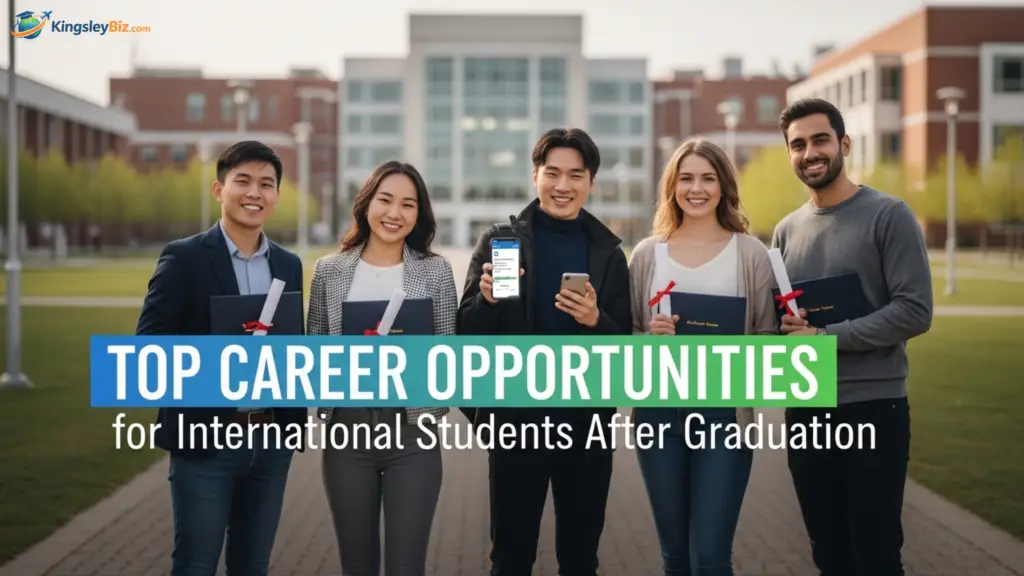
Completing your degree abroad is a major achievement, but for many international students, the question that follows is just as important: what next? Whether you want to build your career in your study country, return home with new expertise, or pursue opportunities in a third country, this guide covers the best career pathways for international students after graduation in 2026.
Post-Study Work Visa Options by Country
- Canada: Post-Graduation Work Permit (PGWP) — valid for up to 3 years depending on program length
- UK: Graduate Route Visa — allows international graduates to work for 2 years (3 years for PhD graduates)
- Australia: Temporary Graduate Visa (Subclass 485) — 2 to 6 years depending on qualification and location of study
- Germany: 18-month job-seeker visa after graduation — allows graduates to search for work in Germany
- USA: Optional Practical Training (OPT) — 1 year (3 years for STEM graduates)
- New Zealand: Post-Study Work Visa — up to 3 years
Top Industries Hiring International Graduates in 2026
- Technology (Software Engineering, Data Science, AI/ML): High demand globally, especially in the USA, UK, Canada, and Germany
- Healthcare and Nursing: Acute shortage of healthcare professionals in Canada, Australia, UK, and Germany
- Engineering (Civil, Mechanical, Electrical): Strong demand in infrastructure-heavy economies
- Business, Finance and Accounting: Multinational corporations actively recruit internationally educated graduates
- Education and Research: Postdoctoral and teaching positions in major research universities
- Renewable Energy and Sustainability: A fast-growing sector with significant international hiring
Strategies for Landing Your First Job After Graduation
- Start applying 3–6 months before graduation — do not wait until after you graduate
- Attend campus career fairs and employer networking events organized by your university
- Optimize your LinkedIn profile and connect with recruiters and alumni in your target field
- Use your university’s career services centre for resume reviews, mock interviews, and job posting access
- Target employers with a track record of sponsoring or hiring international workers
- Consider graduate programs and graduate scheme applications — many are open specifically to recent international graduates
Should You Return Home or Stay Abroad After Graduation?
This is one of the most common questions international graduates face. There is no universal answer, but here are some key considerations.
- Staying abroad: Higher salaries, career advancement, and potential pathway to permanent residency
- Returning home: Strong professional network, lower cost of living, opportunity to leverage your international degree for leadership roles
- Third-country option: If your home country’s job market is limited and your study country’s visa options are restrictive, explore emerging markets or countries with easier immigration routes
- Many international graduates pursue a hybrid approach — working abroad for 3–5 years before returning home with capital, experience, and connections
FAQs
Q: Which country is best for international graduates to find jobs?
A: Canada, Germany, and Australia are often cited as the most accessible for international graduates due to their post-study work visa programs and clear immigration pathways to permanent residency.
Q: Do I need a job offer before my post-study visa expires?
A: This depends on the country. In Germany, you have 18 months specifically to find a job. In Canada, your PGWP allows you to work for any employer without a specific offer first.
Q: How do I get my foreign degree recognized in my home country?
A: Contact your home country’s professional certification body or ministry of education. Many countries have academic credential evaluation services that assess the equivalence of foreign degrees.
Conclusion
Graduating with an international degree opens doors in virtually every part of the world. The key is to plan your career strategy before you graduate — not after. Research post-study visa options early, build your professional network while still in school, and tailor your job applications to the specific market you are targeting. Your international education is a powerful asset. Use it strategically.