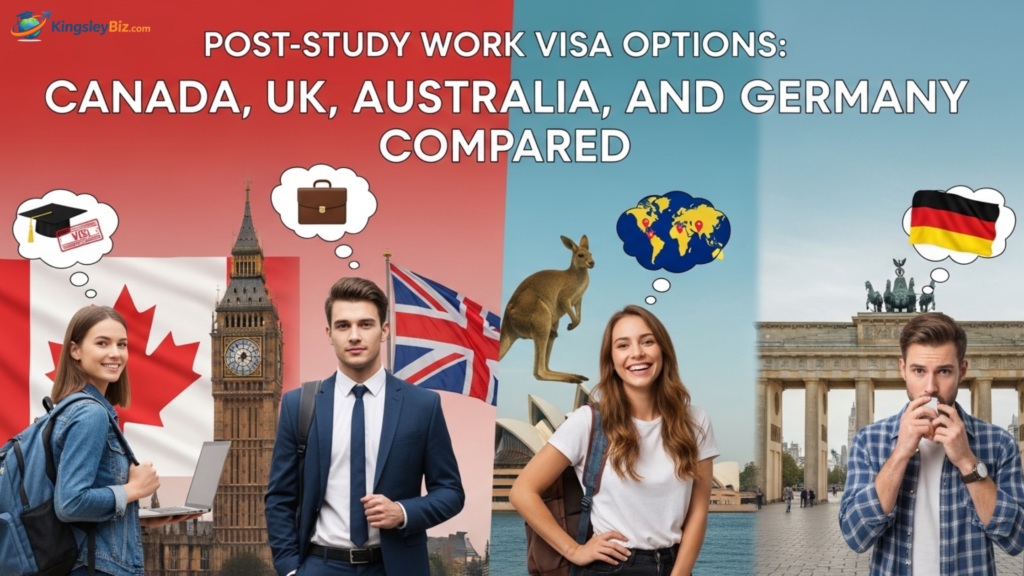
One of the most important factors international students consider when choosing a study destination is what happens after graduation. Can you stay and work? For how long? Can you bring your family? Does it lead to permanent residency? The answers vary enormously from country to country. In this guide, we compare the post-study work visa options in four of the most popular study abroad destinations — Canada, the UK, Australia, and Germany — so you can make the most informed decision for your future.
Canada: Post-Graduation Work Permit (PGWP)
- Visa name: Post-Graduation Work Permit (PGWP)
- Duration: Up to 3 years (duration depends on the length of your program — master’s degree holders receive 3 years automatically)
- Eligibility: Graduates of eligible designated learning institutions (DLIs) in Canada who studied full-time in a program of at least 8 months
- Work type: Open work permit — work for any employer, in any province, in any occupation
- Language requirement: CLB 7 (most programs) or CLB 5 (some trades) as of 2024
- Cost: CAD 255 application fee + CAD 85 biometrics
- Pathway to PR: Yes — Canadian Experience Class (CEC) via Express Entry is available after 12 months of eligible skilled work
- Spouse/partner: Eligible for an open spousal work permit
- Rating: Outstanding — the most flexible and PR-friendly post-study work permit in the world
💡 Best for: Students who want open work rights, a clear and fast track to permanent residency, and the ability to work in any field.
United Kingdom: Graduate Route Visa
- Visa name: Graduate Route Visa (formerly Post-Study Work Visa)
- Duration: 2 years for bachelor’s and master’s graduates; 3 years for PhD graduates
- Eligibility: Must have studied in the UK on a Student Visa and successfully completed an eligible degree at a UK Higher Education Provider
- Work type: Open — you can work or look for work in almost any role, though some highly regulated professions have additional requirements
- Language requirement: Met by virtue of your UK Student Visa application
- Cost: GBP 822 application fee + NHS surcharge (approximately GBP 1,035 per year)
- Pathway to PR: No direct route from the Graduate Visa — you typically must transition to a Skilled Worker Visa (requires a job offer and sponsorship), then apply for Indefinite Leave to Remain (ILR) after 5 years
- Spouse/partner: Your partner may be eligible to apply as a dependent on the Graduate Route
- Rating: Good — excellent for exploring the UK job market, but the path to PR is longer and less straightforward than Canada
💡 Best for: Students targeting the UK job market who want 2–3 years to find an employer willing to sponsor their Skilled Worker Visa.
Australia: Temporary Graduate Visa (Subclass 485)
- Visa name: Temporary Graduate Visa (Subclass 485), Post-Study Work Stream
- Duration: 2 years (bachelor’s) to 4 years (PhD) — add 2 extra years if studied in regional Australia
- Eligibility: Must have held an Australian Student Visa (Subclass 500), studied in Australia for at least 2 years, and apply within 6 months of course completion
- Work type: Open — full work rights, any employer, any occupation
- Language requirement: IELTS 6.0 overall (equivalent in TOEFL, PTE, or Cambridge)
- Cost: AUD 1,895 main applicant + health insurance (OVHC)
- Pathway to PR: Strong — work experience on the 485 counts toward skilled migration points. Subclass 189, 190, and 491 visas are common next steps. Employer sponsorship (482/186) is also common.
- Spouse/partner: Can be included as secondary applicants with work rights
- Rating: Excellent — the additional years for regional study make this particularly powerful for strategic applicants
💡 Best for: Students who want a long runway after graduation to explore careers, and who want a strong pathway to Australian permanent residency or citizenship.
Germany: Post-Study Job Seeker Visa
- Visa name: Job Seeker Visa for Graduates (18-month extension to residence permit)
- Duration: 18 months after graduation to look for qualified employment
- Eligibility: International students who have completed a degree at a German university (or an equivalent degree in Germany) recognized in Germany
- Work type: During the job search period — up to 20 hours per week in any role. Once you find a qualified job, you transition to a full EU Blue Card or skilled worker residence permit with full work rights.
- Language requirement: German B2 or C1 is practically essential for most job markets; some English-taught tech and engineering roles are available
- Cost: Residence permit extension fee: approximately EUR 100. Very low overall visa fees compared to other countries.
- Pathway to PR: Very strong — EU Blue Card holders can apply for permanent residency after 21 months (if German language B1 is met) or 33 months. After 5 years of legal residence, you can apply for German citizenship.
- Spouse/partner: Spouse can join you with their own residence permit and work rights if income requirements are met
- Rating: Exceptional for those who plan to stay in Europe long-term, especially given Germany’s strong economy and ease of EU citizenship pathway
💡 Best for: Graduates with in-demand technical skills (engineering, IT, medicine) who want to build careers in Europe and eventually pursue German and EU citizenship.
Side-by-Side Comparison Summary
Here is how the four post-study work options compare across key metrics:
- Duration: Australia leads (up to 6 years in regional) > Canada (up to 3 years) > UK (up to 3 years for PhD) > Germany (18-month job search, then indefinite if employed)
- Work rights: Canada and Australia offer the most flexible open work permits from day one. Germany restricts hours during job search phase. UK offers open rights but requires transition to Skilled Worker Visa for PR.
- Pathway to PR: Canada is fastest and most transparent (CEC via Express Entry, 12 months experience). Germany is excellent for Blue Card holders (21-33 months). Australia is strong but requires skills points. UK requires employer sponsorship.
- Cost: Germany is most affordable. Canada and UK are moderate. Australia is highest (mainly due to health insurance requirements).
- Language barrier: English-only speakers face the lowest barriers in Canada, UK, and Australia. Germany requires significant German language competency for long-term career success.
- Family: All four countries allow your partner and/or children to join you, though conditions and work rights for dependents vary.
Which Country Is Best for Your Post-Study Career?
The answer depends entirely on your personal goals, career field, and long-term plans.
- Choose Canada if: You want the fastest and most straightforward path to permanent residency, English is your primary language, and you want maximum flexibility to work in any job.
- Choose Australia if: You want the longest post-study visa duration, you prefer a warm climate and Pacific lifestyle, and you are open to working in regional areas for extra visa time.
- Choose the UK if: You have a specific career goal in finance, law, creative industries, or academia that is best served by the UK job market and you are willing to find an employer sponsor within 2-3 years.
- Choose Germany if: You are in engineering, IT, medicine, or research; you are willing to learn German; and you want access to the entire EU job market and one of the strongest economies in the world.
FAQs
Q: Which country gives the longest post-study work visa?
A: Australia gives the longest — up to 6 years for PhD graduates who studied in regional Australia. Canada’s maximum is 3 years. The UK gives 3 years for PhD graduates and 2 years for others.
Q: Which post-study work visa leads to permanent residency fastest?
A: Canada is generally the fastest — the Canadian Experience Class via Express Entry allows applications for PR after just 12 months of skilled work experience, with typical processing times of 6 months.
Q: Can I work any job on a post-study work visa?
A: In Canada and Australia, yes — these are open work permits with no occupation restrictions. In the UK, it is also largely open but some regulated professions have additional requirements. In Germany, you are limited to 20 hours per week until you secure a job matching your qualifications.
Q: What happens if I cannot find a job during my post-study work period?
A: In Canada and Australia, your visa stays valid regardless of employment status. In Germany, failing to find qualified employment within the 18-month window means you must leave. In the UK, you must transition to a Skilled Worker Visa (requiring a job offer) before the Graduate Route expires.
Conclusion
All four countries — Canada, the UK, Australia, and Germany — offer genuine, valuable opportunities for international graduates to build careers and, in most cases, pursue permanent residency. The best choice ultimately comes down to your personal circumstances: your career field, your language skills, your timeline for residency, and your budget. Use this comparison as a starting point, research the specific visa rules for your nationality and qualification level, and speak with a registered immigration adviser if you need personalized guidance. Your post-study work visa is not the end of your journey — it is the beginning of your career.