
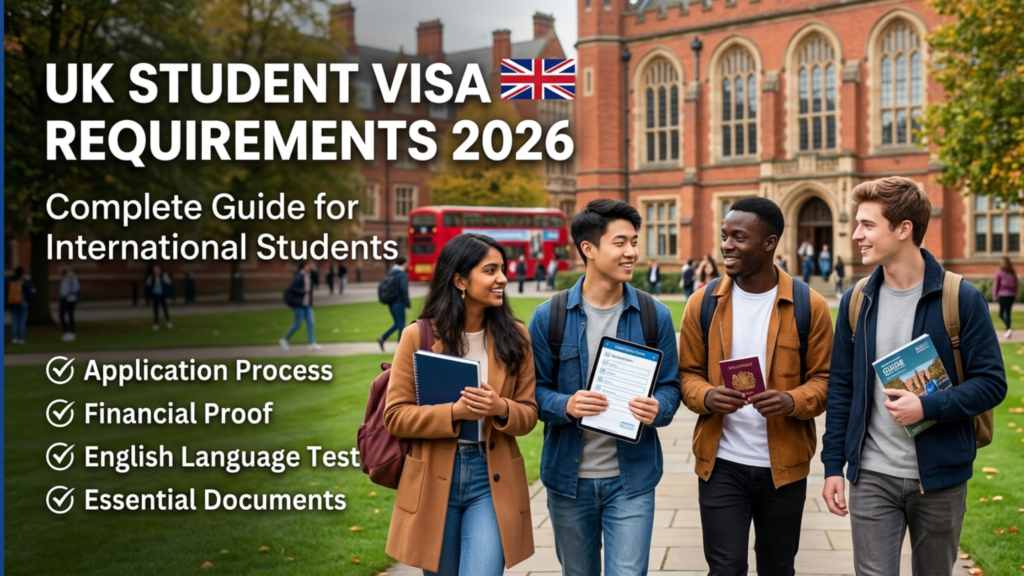
Every year, thousands of students from Nigeria, Ghana, Kenya, and across Africa make the journey to the United Kingdom to study at some of the world’s most prestigious universities. The UK is home to institutions like Oxford, Cambridge, UCL, and Imperial College — universities that open doors globally. But before you can set foot on campus, you need one thing: a valid UK student visa.
Getting the UK student visa right is not complicated once you understand the process — but the mistakes that lead to refusals are almost always avoidable. Wrong financial documents, incomplete CAS details, or missing biometric appointments are the reasons most applications fail. This guide walks you through every requirement, every document, and every step so you can apply with confidence in 2026.
Whether you are applying from Lagos, Accra, or Nairobi, this guide covers exactly what you need. If you are also considering Canada as an alternative destination, you can read our Canada Student Visa Guide 2026 for a full comparison.
| 🎯 Quick Answer: What is the UK Student Visa?The UK Student Visa (formerly Tier 4) allows international students aged 16 and over to study a full-time course at a licensed UK university or college. To apply, you need a Confirmation of Acceptance for Studies (CAS) from your university, proof of English proficiency, proof of funds, and a valid passport. The application fee is £490 for applications made outside the UK, and processing typically takes 3–6 weeks. |
Overview: The UK Student Visa 2026
The UK Student Visa is issued by UK Visas and Immigration (UKVI), part of the Home Office. It replaced the old Tier 4 (General) Student Visa and operates under the same core principles — you must be sponsored by a Home Office-licensed educational institution, meet financial requirements, and demonstrate genuine intent to study.
The visa allows you to study your full programme, work part-time (up to 20 hours per week during term time, full-time during holidays), and in some cases bring dependants. It is valid for the duration of your course plus additional time to allow for travel.
| Detail | Information |
| Visa Type | UK Student Visa (formerly Tier 4) |
| Issuing Authority | UK Visas and Immigration (UKVI) |
| Application Fee (Outside UK) | £490 (~₦950,000 / GHS 8,800) |
| Healthcare Surcharge | £776 per year of study |
| Processing Time | 3–6 weeks (standard) |
| Work Permission | Up to 20 hrs/week during term; full-time in holidays |
| Dependants Allowed | Yes, for postgraduate courses of 9+ months |
UK Student Visa Requirements 2026
To qualify for a UK Student Visa, you must meet the following conditions. Every requirement must be satisfied — UKVI assesses your application as a whole.
1. University Offer and CAS Number
You must have an unconditional offer from a UK university or college that holds a valid Student Sponsor Licence. Your institution will issue you a Confirmation of Acceptance for Studies (CAS) — a unique 14-character reference number that you include in your visa application. Without a CAS, you cannot apply.
2. English Language Proficiency
You must demonstrate that your English is good enough for your course. Accepted qualifications include:
- IELTS Academic: Minimum 5.5–7.0 depending on course level
- TOEFL iBT: Minimum 72–100 depending on course level
- Pearson PTE Academic: Minimum 59 (most universities)
- Degree taught entirely in English from a recognised country
- Some universities accept their own English tests — check with your institution
3. Proof of Funds (Financial Requirements)
This is where most applications from Africa fail. UKVI requires you to show you can cover your tuition fees and living costs. The exact amounts for 2026:
| Situation | Amount Required (GBP) | Approx. NGN |
| London tuition (per year) + living | Tuition + £1,334/month | Varies by course |
| Outside London living costs | £1,023/month | ~₦2,000,000/month |
| London living costs | £1,334/month | ~₦2,600,000/month |
| Funds must be held for | 28 consecutive days | Before application date |
| Bank statement date | Must be within 31 days of application | Recent statements only |
You must show funds covering 9 months of living costs (or the full course length if shorter than 9 months), plus your first year’s tuition fees. Funds must be in your name or a parent/legal guardian’s name — and must have been held in the account for at least 28 consecutive days.
4. Valid Passport
Your passport must be valid for the entire duration of your stay in the UK. If your passport expires before your course ends, renew it before applying for your visa.
5. Genuine Student Requirement
UKVI may interview you (via video call) to confirm you are a genuine student. Be prepared to explain why you chose the UK, your university, and your specific course. This is particularly common for applicants from Nigeria.
6. ATAS Certificate (For Certain Subjects)
If your course involves certain sensitive subjects (advanced physics, chemistry, engineering, mathematics at postgraduate level), you may need an Academic Technology Approval Scheme (ATAS) certificate from the UK Foreign, Commonwealth & Development Office before applying. Your university will advise you if this applies to your course.
Required Documents Checklist
Gather every document on this list before you start your online application. Incomplete applications are a leading cause of delays and refusals.
- Valid passport (scan of photo page + all previous UK visas)
- Confirmation of Acceptance for Studies (CAS) number from your university
- Evidence of English language proficiency (IELTS certificate, etc.)
- Bank statements showing required funds held for 28+ days
- Sponsor letter (if funds are from a parent or guardian — must confirm relationship and financial support)
- Tuberculosis (TB) test results if applying from Nigeria, Ghana, or Kenya (mandatory)
- ATAS certificate (if required for your subject)
- Academic qualifications — degree certificates, transcripts, A-Level or WAEC/NECO results
- Proof of accommodation in the UK (university hall confirmation or private tenancy agreement)
- Parental consent letter (if you are under 18)
Tip: Document preparation can be stressful, especially getting bank statements formatted correctly. iVisa (20% off with code SHARE20) can help you check and organise your visa documents before submission — use code SHARE20 for 20% off.
Step-by-Step Application Process
Follow these steps in order. Do not begin your application before you have your CAS number from your university.
Step 1: Receive Your CAS from Your University
Your university will send you a CAS number after you accept an unconditional offer. This number is valid for 6 months from the date of issue. Make note of all details on your CAS — they must match your application exactly.
Step 2: Complete the Tuberculosis (TB) Test
If you are applying from Nigeria, Ghana, or Kenya, you must complete a TB test at an approved clinic before applying. In Nigeria, approved clinics include those in Lagos, Abuja, Port Harcourt, and other cities. Results are valid for 6 months. Book early — appointments can take 2–3 weeks.
Step 3: Create Your UK Visas and Immigration (UKVI) Account
Go to gov.uk/student-visa and create your online account. This is the official UKVI portal — do not use any other website to submit your application.
Step 4: Complete the Online Application Form
Fill in all sections carefully. Your personal details must match your passport exactly. Enter your CAS number when prompted. Upload scanned copies of all required documents — make sure scans are clear and in colour.
Step 5: Pay the Application Fee and Healthcare Surcharge
You must pay both the visa application fee (£490) and the Immigration Health Surcharge (IHS) at the time of application. The IHS is £776 per year of your course — so a 3-year undergraduate degree costs £2,328 in healthcare surcharge alone. Payment is made by card during your online application.
Step 6: Book and Attend Your Biometric Appointment
After paying, you will be directed to book a biometric appointment at your nearest Visa Application Centre (VAC). In Nigeria, VACs are in Lagos and Abuja. In Ghana, the VAC is in Accra. Bring your passport and the appointment confirmation. Your fingerprints and photograph will be taken.
Step 7: Wait for a Decision
Standard processing takes 3–6 weeks from the date of your biometric appointment. You can pay extra for priority processing (5 working days) or super-priority (next working day) if available in your country. Track your application status through your UKVI online account.
Step 8: Collect Your Visa
If approved, your visa will be stamped in your passport or issued as a vignette sticker. Check all details for accuracy immediately. A Biometric Residence Permit (BRP) — your official UK identification card — will be ready to collect from a UK Post Office within 10 days of your arrival in the UK.
UK Student Visa Costs 2026 (Full Breakdown)
Budget carefully — the total cost of getting your UK student visa is often higher than people expect. Here is the complete breakdown:
| Fee Item | GBP (£) | NGN (₦ approx.) | GHS (₵ approx.) |
| Visa Application Fee | £490 | ~₦950,000 | ~₵8,800 |
| Healthcare Surcharge (per year) | £776/yr | ~₦1,510,000/yr | ~₵13,900/yr |
| TB Test (Nigeria/Ghana/Kenya) | Varies (~£50–80) | ~₦100,000–₦155,000 | ~₵900–1,400 |
| Biometric Appointment | Included in fee | — | — |
| Priority Processing (optional) | £500 extra | ~₦970,000 | ~₵8,900 |
| ATAS Certificate (if needed) | Free | Free | Free |
| Total (3-year degree, no priority) | ~£2,798+ | ~₦5.4 million+ | ~₵50,000+ |
Note: GBP to NGN conversion based on ~₦1,940/£1. GBP to GHS based on ~₵18/£1. Rates change — verify before budgeting.
Processing Times
| Service Type | Processing Time | Extra Cost |
| Standard Processing | 3–6 weeks | Included in application fee |
| Priority Processing | 5 working days | +£500 |
| Super Priority | Next working day | +£1,000 (where available) |
| Decision after biometrics | Clock starts after appointment | — |
Apply at least 6 weeks before your course start date to allow for processing time, especially during peak periods (June–September). If you need a TB test, factor in an additional 2–4 weeks before your application.
Tips for Getting Your UK Student Visa Approved
- Get your TB test done first — this is the step most applicants delay, and it controls your entire timeline. Book it as soon as you accept your university offer.
- Do not apply before receiving your CAS — applying without a valid CAS number means an automatic refusal.
- Hold your funds for 28 full consecutive days before your application date — the bank statement must clearly show this. Day 1 of holding = Day 1 of the 28-day window.
- Use your own or parent/guardian bank statements only — accounts must be in names that match your application. Third-party funds from aunties or distant relatives are a red flag.
- Prepare for the genuine student check — know your course structure, why you chose that university, and your career plans. Have this ready even if no interview is requested.
- Match everything to your CAS exactly — your name, date of birth, and passport number in your application must be identical to what is on your CAS.
Important: Most African applicants do not have UK health insurance on arrival. Provincial NHS registration typically takes time to process after you arrive. Bridge this gap with SafetyWing international health insurance from ~$45/month — it covers 180 countries and activates immediately.
- Book the earliest biometric appointment available — slots fill up in Lagos and Accra during peak season. Do not wait until your CAS is about to expire.
- Apply online only — never use third-party agents who claim to ‘guarantee’ visa approval. UKVI only accepts direct applications through their official portal.
Common Mistakes That Lead to Refusals
| Mistake | Why It Causes Refusal | How to Avoid It |
| Wrong financial documents | Funds not held for 28 days or account not in applicant’s/sponsor’s name | Check statements 28+ days before applying; only use your own or parent’s account |
| Applying before TB test is done | Application incomplete; UKVI will not process without TB clearance | Book TB test immediately after getting CAS |
| Mismatch between passport and CAS | Name or DOB discrepancy triggers automatic rejection | Check your CAS details against your passport character by character |
| Uploading unclear documents | Blurry or incomplete scans are rejected as unverifiable | Use a scanner — phone camera photos are often rejected |
| No ATAS certificate for eligible subjects | UKVI refusal for non-exempt science/engineering courses | Ask your university if your course requires ATAS before applying |
| Weak genuine student response | UKVI not satisfied you intend to study and return home | Prepare a clear statement on course choice, career goals, and home ties |
Frequently Asked Questions
How long does a UK student visa take to process in Nigeria?
Standard processing takes 3–6 weeks from the date of your biometric appointment at the Visa Application Centre in Lagos or Abuja. If you apply during peak season (June–September), allow additional time. Priority processing (5 working days) is available for an extra £500.
Can I work while studying in the UK on a student visa?
Yes. The UK Student Visa allows you to work up to 20 hours per week during term time and full-time (unlimited hours) during official university holiday periods. You cannot work as a professional sportsperson, entertainer, or in most self-employed capacities.
How much money do I need to show for a UK student visa from Nigeria?
You need to show your first year’s tuition fees plus 9 months of living costs (£1,023/month outside London or £1,334/month in London). These funds must be held in your or your sponsor’s bank account for at least 28 consecutive days before your application date.
Do I need to take a TB test for a UK student visa?
Yes, if you are applying from Nigeria, Ghana, or Kenya — among many other countries — a tuberculosis (TB) test from a UKVI-approved clinic is mandatory. Results must be less than 6 months old at the time of your application. Check the full list of countries requiring TB tests at gov.uk.
Can iVisa help me apply for my UK student visa?
Yes. iVisa (20% off with code SHARE20) can help you review your documents, check your application form for errors, and guide you through the submission process — particularly useful for first-time applicants. Use code SHARE20 for a 20% discount on all iVisa services.
Can I bring my family with me on a UK student visa?
Dependants (spouse/partner and children under 18) are allowed if you are a postgraduate student on a course of 9 months or longer at a higher education institution. Undergraduate students cannot bring dependants. Each dependant must apply separately and meet their own financial requirements.
What happens to my UK student visa if I defer my course?
If you defer your course start date, your current CAS will likely be cancelled by your university, and you will need a new CAS for the deferred start. You may need to reapply for your student visa. Contact your university’s international student office immediately if you are considering a deferral.
Do I need health insurance for the UK as a student?
You pay the Immigration Health Surcharge (£776/year) as part of your visa application, which gives you access to the NHS. However, NHS registration can take time after arrival. We recommend SafetyWing international health cover from $45/month to cover you from the moment you land.
Is the UK student visa the same as the old Tier 4 visa?
Yes. The UK Student Visa replaced the Tier 4 (General) Student Visa in October 2020. The requirements are largely the same, but the application process is fully online. If anyone refers to a ‘Tier 4 visa’ in 2026, they mean the current UK Student Visa.
Conclusion
The UK Student Visa is one of the most accessible routes to a world-class education — and with the right preparation, your application should go smoothly. The key is to start early: get your TB test booked as soon as your offer is confirmed, gather your financial documents well in advance, and make sure every detail on your application matches your CAS and passport exactly.
If you are weighing up the UK against other destinations, our Canada Student Visa Guide 2026 and Top Fully Funded Scholarships for African Students are good next reads. And if you are applying for a Chevening Scholarship alongside your student visa, our Chevening Scholarship 2026 Guide covers every step of that application.
| Ready to Take the Next Step? | |
| 📄 Sort Your Visa Documents: Get expert document checking and visa processing support with iVisa — KingsleyBiz readers save 20% with code SHARE20. Use iVisa with 20% off (code SHARE20) → | 🌍 Get Health Cover from Day One: Don’t arrive in the UK without cover. SafetyWing international health insurance starts from $45/month and covers you from the moment you land. Get SafetyWing — built for international students → |
Affiliate Disclosure
This article contains affiliate links to iVisa and SafetyWing. KingsleyBiz.com may earn a commission if you make a purchase through these links. This is at no extra cost to you and helps us continue providing free immigration and study abroad guides.
Official Sources
gov.uk/student-visa — UK Visas and Immigration (official) | gov.uk — Immigration Health Surcharge | UKCISA — UK Council for International Student Affairs
Disclaimer: All information in this guide is for informational purposes only and is correct as of May 2026. Visa requirements can change. Always verify current requirements at gov.uk before applying.

You’re so awesome! I don’t believe I have read a single thing like that before. So great to find someone with some original thoughts on this topic. Really.. thank you for starting this up. This website is something that is needed on the internet, someone with a little originality!